

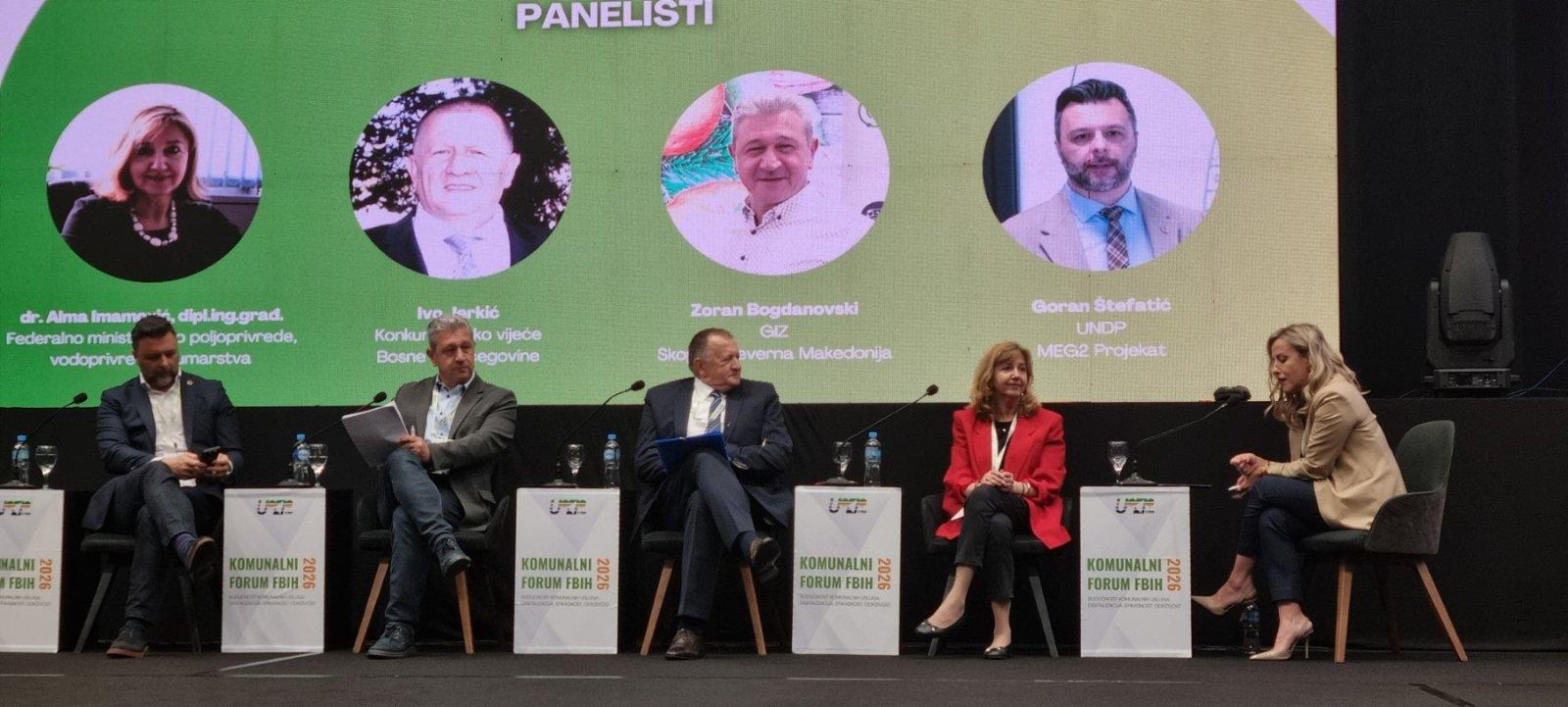
FBiH Public Utility Forum 2026
Organized by UPKP FBiH, the “FBiH Public Utility Forum 2026” was held in Sarajevo on 4 and 5 June, which brought together more than 200 representatives of ministries, utility companies, donors, the academic sector and experts from practice.
During the Forum, numerous and complex challenges faced by the utility sector were pointed out: from chronic losses in systems, outdated infrastructure and insufficient investments, to rising energy costs, pressure on service prices, staffing problems, climate change and the need for accelerated digitization.
The utility sector should be seen as the foundation of quality of life, public health and local development, and not as an expense. Urgent and systemic changes are necessary, with the use of existing knowledge and capacities within the sector. The conclusions of the Forum should be quickly translated into concrete policies, reforms and investments, because through planning and cooperation of all actors, it is possible to provide quality and sustainable services for citizens.
During the presentation on one of the panels, the member of the Competition Council, Ivo Jerkić, pointed out the following as important:
The relationship between the protection of competition and the protection of the public interest:
Utility services (energy, water supply, transport) meet the basic needs of citizens. They are mainly carried out by public companies whose founder is the state (of all levels of government), and they are financed from service charges as well as from the founder’s budget.
However, through various regulations and decisions of the founders, these companies often get a privileged position that may be in conflict with the Law on Competition. This opens up space for abuse of a dominant position on the market. In such cases, the responsibility for violating the law is not only borne by the company, but also by the founder who enabled it to have such a position on the utility market.
Regulatory obstacles that slow down the development and more efficient operation of utility companies:
Public enterprises and their founders must work together to harmonize the Law on Utilities with the Law on Competition.
Practice shows that the biggest problem often lies not in the laws themselves, but in the implementing acts (decisions, regulations, etc.). For this reason, it is necessary to first request the opinion of the Competition Council when adopting any regulation that may affect market competition.
The active participation of the members of the Competition Council of Bosnia and Herzegovina, Ivo Jerkić and Vanja Malidžan, at the forum confirmed the commitment of the Competition Council to contribute to the transformation of the utility industry into a modern and self-sustaining system that provides citizens with the highest quality of services.
